
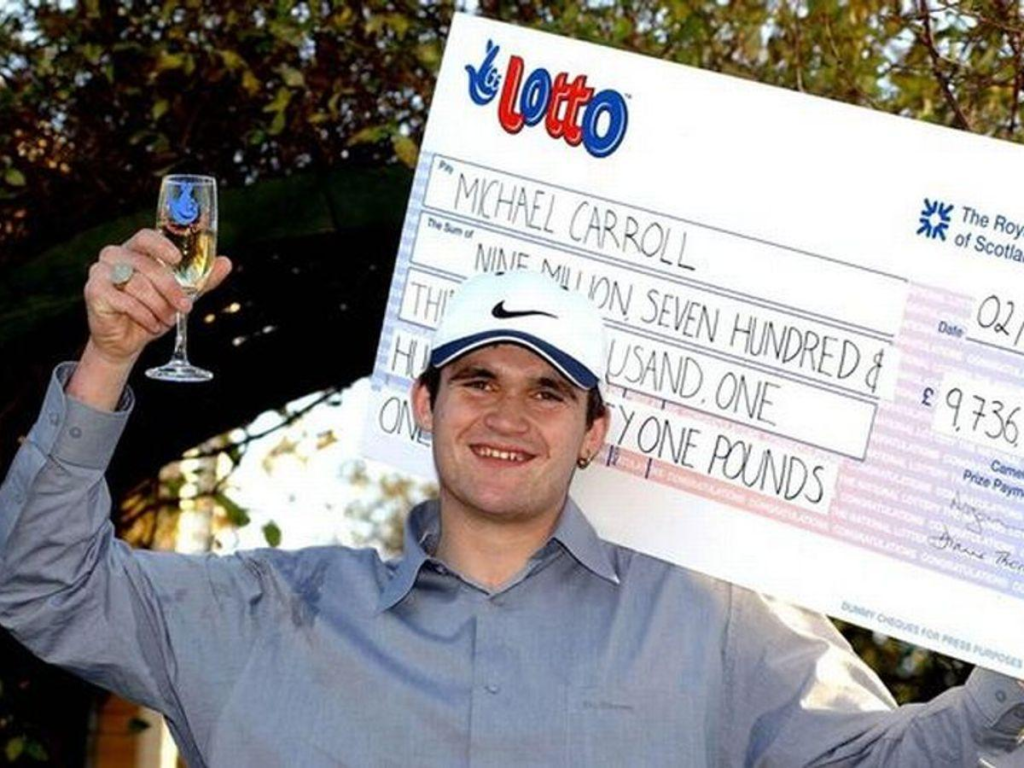
At 19, Michael Carroll won enough money to transform his life forever. Eight years later, the fortune was gone. His real-life story shows how sudden wealth can disappear when freedom arrives without preparation.
In November 2002, Michael Carroll was a 19-year-old refuse collector from Norfolk, England. He had little money, no established financial experience and was reportedly wearing an electronic monitoring tag when he purchased the ticket that would change his life.
That ticket won him approximately £9.7 million in the UK National Lottery. Almost overnight, the teenager went from collecting rubbish to becoming one of Britain’s most famous young millionaires.
The jackpot appeared to offer unlimited possibilities. Carroll could have lived comfortably for the rest of his life. Instead, the money opened the door to years of uncontrolled spending, destructive behaviour and relentless public attention.
A millionaire without limits
Carroll’s new lifestyle developed quickly. He bought a six-bedroom mansion in Norfolk, acquired expensive cars and invested about £1 million through a financial arrangement connected with Glasgow Rangers, the football club he supported. He also distributed substantial amounts of money among relatives and later paid a large divorce settlement.
The mansion became the centre of his social life. Friends gathered there for long parties involving heavy drinking and drugs. Vehicles were reportedly used in destructive races around the property, while luxury purchases, jewellery, holidays and entertainment steadily consumed the fortune.
For someone who had never possessed significant wealth, the jackpot removed nearly every financial restriction at once. Spending no longer appeared to carry immediate consequences. There was always another account to access, another possession to sell or another portion of the prize to withdraw.
But even £9.7 million is finite.
Fame made the situation worse
Carroll’s behaviour attracted intense coverage from Britain’s tabloid press, which labelled him the “Lotto Lout.” He became known not simply as a lottery winner, but as a public symbol of reckless excess.
The attention encouraged an image built around money, rebellion and spectacle. His parties and confrontations generated headlines, while his legal problems increasingly became part of the story surrounding his fortune.
In 2006, Carroll received a nine-month prison sentence for affray following a violent incident involving a baseball bat. Reports from the period also described earlier punishment connected with his failure to comply with a drug-treatment order.
The lottery had solved his immediate financial problems, but it had not provided discipline, stability or protection from his existing difficulties. Instead, wealth gave those problems more room to grow.
The fortune begins to disappear
As Carroll continued spending, his assets and available cash declined. Properties, cars, gifts, legal costs, settlements, parties and drugs absorbed money at a pace that even a multimillion-pound jackpot could not sustain.
By 2006, only four years after his win, reports were already describing him as close to running out of money. Carroll disputed some claims about exactly how little remained, but the direction of his finances was clear. The lifestyle could not continue indefinitely.
The final collapse came in 2010, when Carroll was declared bankrupt. The teenager who had once received almost £10 million had exhausted the fortune in roughly eight years.
His story was no longer about what he could buy. It was about what remained after the money stopped.
Returning to an ordinary life
After losing his wealth, Carroll returned to regular employment, including refuse-collection work similar to the job he had held before winning the lottery. The extravagant homes, luxury vehicles and constant parties were replaced by wages, routine and financial limits.
Carroll has said that he does not regret the entire experience, although he has expressed regret about his drug use. His response complicates the familiar idea that every ruined winner considers the jackpot a curse. From his perspective, the money financed several extraordinary years—even though those years ultimately left him bankrupt.
That does not make the outcome less severe. Winning the lottery gave him an opportunity for permanent financial security, but the absence of restraint allowed a life-changing prize to become temporary entertainment.
The lesson behind the lost millions
Michael Carroll’s experience is often presented as proof that lottery winners inevitably destroy their lives. That conclusion is too simple. Many winners preserve their money, continue working, support their families or invest carefully.
Carroll’s case offers a more specific warning: money can expand a person’s choices without improving their judgment.
A sudden fortune requires more than a bank account. It requires professional financial advice, legal protection, controlled access to funds and the willingness to say no—to friends, relatives and personal impulses. Without those safeguards, millions can feel limitless until very little remains.
Carroll beat extraordinary odds to win £9.7 million. But preserving that money required a different kind of discipline—one that luck could not provide.